How to Keep Homeschool High School Records That Build a Great Transcript
 Homeschool Reports9 min read
Quick answer
The homeschool high school records you need are simpler than most moms fear: a course list with grades and credits, samples of real work, a reading list, and a running log of activities and awards. Keep those four things updated as you go, and the transcript is just a tidy summary of what you already have — not a frantic reconstruction in twelfth grade.
Almost every homeschool transcript panic starts the same way. It’s the fall of senior year, an application deadline is three weeks out, and Mom is sitting on the floor surrounded by four years of loose papers trying to remember whether that biology course finished in tenth grade or eleventh. The truth is that homeschool high school records are not hard to keep. They’re just hard to recreate. That’s the whole difference. If you’d like the easy version, you can keep everything in one free account and let the transcript build itself as you go — but even a shoebox and a notebook will work if you start now.
This guide walks through exactly what to save from the first day of ninth grade, how to assign credits honestly, and how the pieces snap together into a transcript a college admissions office will take seriously.
The records that actually feed a transcript
A transcript is a one-page summary. Everything on it has to come from somewhere, and that somewhere is your records. Here’s the honest mapping — what you keep on the left, what it becomes on the right.
| What you keep during the year | What it becomes on the transcript |
|---|---|
| Course name, curriculum used, dates | The course line itself |
| Assignment and test scores | The letter grade and GPA |
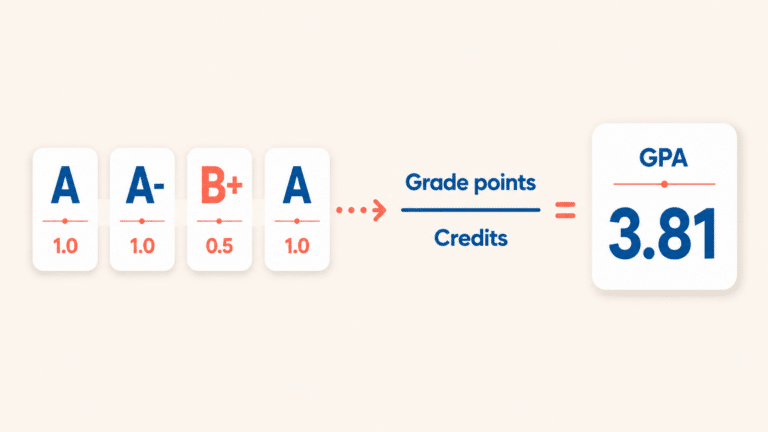
| Hours logged or textbook completed | The credit value (1.0, 0.5) |
| Work samples and reading lists | Course descriptions and portfolio backup |
| Activities, service, jobs, awards | The extracurricular sheet that goes with the application |
| Standardized and college-entrance test scores | The test score block |
HSLDA recommends keeping work samples from all four years, course descriptions, outside report cards, partial transcripts from any school attended, and test scores — and keeping report cards, transcripts, test scores and immunization records permanently (HSLDA, The Essentials of High School Recordkeeping).
You are not building a transcript in senior year. You are printing one.

Tracking grades and credits as you go
This is where most families stall, because “how many credits is that?” feels like a question only a real school gets to answer. It isn’t. The traditional standard is the Carnegie unit: roughly 120 hours of study in one subject equals one credit, with many families aiming higher and some states expecting up to 180 hours per credit. A half credit is about half that.
If you would rather write them down than type them, the printable high school report card template has a credit column built in.
There’s a shortcut most people miss. If your teen is working through a standard high-school-level textbook cover to cover, you generally don’t need to log hours at all — finishing the text is the credit. Log hours for the courses that don’t come in a book: the welding apprenticeship, the year of piano, the self-designed marine biology elective, the 4-H project that turned into a real study of animal husbandry.
- Record the grade when you grade it, not in June
- Write the credit value down the day the course ends
- Note the curriculum title and edition — you’ll want it for course descriptions
- Check your own state’s expectations before you assume 120 hours is enough
- Don’t average four years of grades from memory
- Don’t guess at credits after the fact to make a transcript look full
- Don’t leave a finished course unrecorded because “I’ll remember it”
Requirements vary a lot by state, and high school reporting is where the differences bite hardest. Our plain-English homeschool laws by state guide is a good place to check what your state actually asks of you before you set your credit policy.
Tired of the credit math? Track courses, grades and credits free →
Saving samples and reading lists

Grades tell an admissions officer what you concluded. Samples show them why. You don’t need to keep everything — keeping everything is how families end up with six bins and no system. Keep a thin, deliberate slice.
- Two or three samples per coursePick one early piece and one late piece so growth is visible. A lab report, a graded essay, a page of solved problems.
- One running reading list per yearTitle and author, added the week you finish the book. This single list does an enormous amount of work in a course description for English or history.
- Photos countThe finished birdhouse, the science fair board, the recital program. Snap it, name the file with the course and date, and move on.
- Anything graded by someone elseCo-op report cards, dual-enrollment grades, online course certificates. Outside verification is worth more than your own grade book to a skeptical reader.
Keep samples, reading lists and grades together instead of in three places. Open a free records account →
Logging activities, awards, and outside courses
The academic record is only half of an application. The other half is the part homeschool families are often best at and worst at documenting: the volunteering, the part-time job, the church worship team, the years of soccer, the 200 hours of caring for younger siblings while running a small Etsy shop.
Awards & recognition
Contest placements, honor society, competition results, published work.
Service & volunteering
Hours, organization, dates, and what your teen actually did.
Outside coursework
Co-op, dual enrollment, online providers — keep the official record.
Test scores
Standardized, PSAT/SAT/ACT, AP or CLEP. Keep these permanently.
Log these the same month they happen, in the same place as everything else. A separate “activities” notebook that lives in a drawer is a notebook you will not find.
The hard way and the easy way
None of this is complicated. It’s just relentless — four years of small entries that no one reminds you to make. That’s the real reason records get rebuilt in a panic, and it’s exactly the part a system should carry for you.
Rebuilding it later
- Four years of paper in three bins
- Grades reconstructed from memory
- Credits guessed to fill the page
- A spreadsheet you rebuild every August
- Senior year spent on paperwork instead of applications
With Homeschool Reports
- Every course, grade and credit in one place
- Report cards printed as you finish each year
- The transcript assembled from records you already entered
- Attendance and activities logged alongside academics
- Senior year spent on essays and scholarships
Keep four years of high school records in one place
Enter a course once and it flows straight into report cards and the transcript. No spreadsheet to rebuild, no bins to sort, no reconstructing tenth grade from memory.
- Courses, grades and credits tracked year by year
- Professional transcripts and report cards you can print
- Attendance and activity logs beside the academics
- No credit card required
- Free forever plan
- Set up in under 5 minutes
- Cancel any time
Assembling the transcript later
When it’s time, the transcript is an afternoon’s work — not a crisis — because you’re only formatting what already exists. Here’s the shape of the four years.
- 9th gradeSet your credit policy and start the course list. Begin the reading list and the activity log the first week.
- 10th gradeAdd courses, keep two samples each, and file any outside report cards as they arrive.
- 11th gradeAdd college-entrance test scores. Draft course descriptions while the courses are still fresh in your mind.
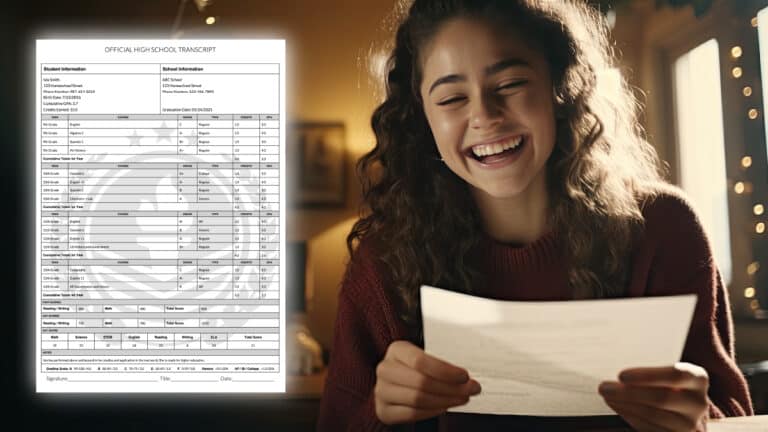
- 12th gradePrint the transcript, calculate the GPA, attach the activity sheet, and send. Then keep the originals permanently.
If you want to see what the finished piece looks like before you commit to a system, read Homeschool Transcripts, Without the Spreadsheet, or look at how our transcript tool and report cards work together from the same records.
“Whoever can be trusted with very little can also be trusted with much.”Luke 16:10
That verse is a surprisingly good record-keeping philosophy. The little thing is writing down a grade the week you assign it. The much is a daughter who applies to college with four confident years behind her, documented, ready, and hers.
Common questions about homeschool high school records
When should I start keeping high school records?
The first week of ninth grade — or today, whichever comes first. If your teen is already partway through high school, start now and reconstruct backward with whatever you have: old curriculum, saved work, calendars, photos. Partial records beat none.
Does high school work done in eighth grade count?
Often, yes. High-school-level courses completed before ninth grade — Algebra I and first-year foreign language are the usual cases — are commonly listed on the transcript with the credit earned. Keep the same records for them that you would for any high school course.
How long do I need to keep these records?
Keep report cards, the transcript, standardized and college-entrance test scores, and immunization records permanently. Work samples and daily logs can generally be thinned out a few years after graduation, once college admission and any state requirements are settled.
What if my state has its own reporting requirements?
Then those come first, and good records make them easy. Requirements differ widely — some states ask for attendance days, some for annual assessments, some for almost nothing. Check your state’s rules directly, or start with our state-by-state guide.
Do I really need course descriptions?
Not for every college, but write them anyway for the courses you designed yourself. A short paragraph naming the materials used, what was covered, and how you graded turns an unfamiliar course title into something an admissions reader can evaluate.
Simple pricing for four years of records
Start free and upgrade only when you need more students.
Starter
Free forever, every feature
$0Free for as long as you like
- Every report included
- Unlimited reports & records
- 1 child, upgrade anytime
Family
Single homeschool family
$39per year (or $9/mo)
- 5 Children + Add More
- Attendance Tracking
- Report Cards & Transcripts
School
Group, co-op, church or school
$149per year (or $49/mo)
- Unlimited children
- Everything in Family
- Manage multiple families
Start your high school records today
Ninth grade or twelfth, the fix is the same: get everything into one place and keep it current. Your future self, three weeks from a deadline, will be so grateful.
- Free plan, no credit card
- Courses, grades, credits and attendance together
- Print a transcript whenever you need one
- No credit card required
- Free forever plan
- Set up in under 5 minutes
- Cancel any time