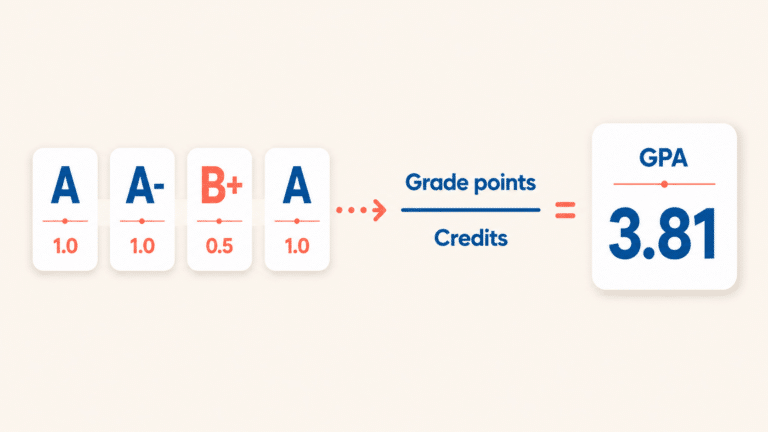
Homeschool Course Credits: How to Name Courses and Assign Credits
 Homeschool Reports10 min read

Quick answer
Give each course a plain, standard name a stranger would recognize (“Biology with Lab,” not “Critters & Creeks”), then award credit by one consistent rule: about 120–180 hours of work, or one full high-school-level textbook, earns 1.0 credit, and half of that earns 0.5. Write the course, the year, the credit and the grade on the transcript, and keep a short note of how you decided.
If you have ever stared at a blank transcript wondering whether your daughter’s year of nature journaling “counts,” you are in very good company. Homeschool course credits sound official and mysterious, but they are really just a way of translating the learning your teen already did into a language colleges, employers and co-ops understand. You are the school here, which means you get to set the rule — you just need to set it once and use it every time.
This guide walks through naming a course, deciding how much credit it earns, handling half credits and electives, and getting it all onto the page. If you would like to follow along with a real transcript as you read, you can open a free account and try each step as we go.
A credit is not a reward. It is a measurement — and you get to choose the ruler, as long as you use the same one every time.
Before we get into the details, here is the whole method on one card:
- Use standard course names that any admissions reader recognizes at a glance.
- Pick one way to measure credit — hours or finished curriculum — and apply it to every course.
- A full-year course earns 1.0 credit; a single semester earns 0.5.
- Electives count when they have real hours and real work behind them.
- Label Honors and AP honestly, and explain your grading scale on the page.
- Record credits every semester, not in a scramble during senior year.
How to name a homeschool course
The person reading your teen’s transcript will spend a few minutes on it, not an afternoon. A course name has one job: tell that reader, instantly, what subject was studied and at roughly what level. Creative unit-study titles are wonderful at the kitchen table. On a transcript, they make a reader guess — and a guessing reader tends to assume less, not more.
So translate. Keep the fun name in your lesson plans and your portfolio, and put the standard name on the homeschool transcript. Here is what that looks like in practice:
| What you called it at home | What goes on the transcript | Credit |
|---|---|---|
| Critters & Creeks | Biology with Lab | 1.0 |
| Our Road Trip Through the Civil War | U.S. History | 1.0 |
| Grandma’s Kitchen Business | Personal Finance | 0.5 |
| Great Books Book Club | English II: World Literature | 1.0 |
| Running Club | Physical Education | 0.5 |
A few naming habits that keep a transcript clean:
- Lead with the subjectStart with the word a school would use — Algebra, Chemistry, Spanish — and add detail after it.
- Number sequencesEnglish I, II, III and IV, or Spanish I and II, show progression at a glance.
- Add “with Lab” when it is trueColleges look for lab sciences specifically, so name them when your teen did the hands-on work.
- Save the story for the course descriptionA short separate course-description page is where the unit study, the books and the field trips get to shine.
Hours vs. mastery: two honest ways to award homeschool course credits
There is no single national rule for how a homeschool awards credit, which is exactly why families freeze here. In practice, nearly everyone uses one of two approaches — and both are respectable when you apply them consistently.
Count the hours
About 120–180 logged hours earns 1.0 credit. Best for electives, PE, fine arts and anything without a textbook.
Finish the curriculum
Completing a full high-school-level text or course earns 1.0 credit, with no hour log needed.
Take a college class
Many families count a one-semester, three-credit dual-enrollment course as 1.0 high school credit.
The classic yardstick is the Carnegie unit: 120 hours of instruction in one subject across a school year. Many homeschool advisors, such as 7 Sisters Homeschool, suggest aiming higher — roughly 135–180 hours for a core class, with extra hands-on time for a lab science. If your teen works about an hour a day, five days a week, for a typical school year, you are comfortably in full-credit territory.
Mastery is simpler for core subjects. If your son works through an entire high school algebra textbook and shows he understands it, that is Algebra I, 1.0 credit, whether it took him 110 hours or 190. What matters is that the text is genuinely high-school level and that he finished it.

You do not have to log every minute forever. Log hours for the courses that need them — electives, PE, independent projects — and let finished curriculum speak for itself in the core subjects. A simple weekly tally in the margin of your planner is plenty.
Want the credits to add themselves up? Build your transcript free →
Half credits and full credits
Credit comes in two common sizes. A course that runs a full school year earns a full credit; a course that runs one semester, or about half the hours, earns a half credit. Quarter credits exist, but most families find they clutter a transcript — if your teen did a short unit, fold it into a related course or combine two short courses into one half-credit elective.
| What your teen did | Typical credit |
|---|---|
| Full school year of a core subject | 1.0 |
| One semester, or roughly 60–90 hours | 0.5 |
| Lab science with regular hands-on labs | 1.0 (name it “with Lab”) |
| One-semester college course (3 college credits) | Commonly 1.0 |
| High school course completed in 8th grade, such as Algebra I | 1.0, listed with the year taken |
That last row surprises many moms. A true high school course finished early can count toward high school credit. List it honestly with the year it was completed, and your teen does not have to repeat work they have already mastered.
Electives that count
Here is where homeschooling shines. Your teen’s real interests — the ones that fill afternoons without being assigned — often add up to legitimate elective credit. The test is the same as any other course: real hours, real work, and something you could describe on a course-description page.
Electives families commonly turn into credit:
- Music lessons and practice — Music or Piano, often 0.5–1.0 per year.
- Driver’s education — usually a 0.5 elective.
- A small business or job skills — Entrepreneurship or Business Fundamentals.
- Sports, dance or martial arts — Physical Education, logged by hours.
- Serious Bible study or apologetics — Bible or Worldview, usually titled plainly.
- Coding, design or a trade skill — Computer Science, Graphic Design or Woodworking.
Graduation requirements for homeschoolers are set by your state (if it sets any) and by the colleges your teen is aiming for, so check your state’s requirements before you plan all four years around electives. Most selective colleges still want to see the core subjects covered first.
“Train up a child in the way he should go: and when he is old, he will not depart from it.”Proverbs 22:6
That verse is a quiet permission slip. The way your teen learns — through a trade, a stage, a garden or a stack of old books — does not have to look like anyone else’s, and naming it well on paper honors the work they genuinely did.
Recording homeschool course credits on the transcript
Once each course has a name and a credit value, recording it is straightforward. Every line on a homeschool transcript carries the same five pieces of information:
- School year or grade levelGroup courses by year so a reader can see the progression from ninth grade to twelfth.
- Course nameThe standard name from your translation, not the unit-study title.
- Course typeRegular, Honors or AP. Label a course AP only if it went through the College Board’s AP Course Audit; otherwise “Honors” is the honest label for advanced work.
- Credit earned1.0, 0.5, and so on, using the rule you chose.
- Final gradeFrom which the GPA is calculated — unweighted, and weighted if you give extra weight to Honors and AP courses.
At the bottom, total the credits earned and show the cumulative GPA, and include a one-line key explaining your grading scale and any weighting. Our guide to keeping homeschool high school records covers the course descriptions, reading lists and work samples that sit behind the transcript.
Building it by hand
- Retyping course names every semester
- Adding up credits with a calculator
- Working out weighted and unweighted GPA yourself
- Reformatting the whole page when one grade changes
With Homeschool Reports
- Pick from 435 ready-made course names, or add your own
- Choose credits from a dropdown, in half steps
- Both GPAs calculated and labeled for you
- A clean, printable transcript in minutes

Let your transcript add up the credits for you
Enter each course once, choose its credit and grade, and Homeschool Reports totals your teen's credits, calculates both GPAs and formats a professional high school transcript you can print today.
- 435 standard course names ready to pick from
- Half and full credits, Honors and AP labels
- Weighted and unweighted GPA, clearly labeled
- No credit card required
- Free forever plan
- Set up in under 5 minutes
- Cancel any time
What it costs
You can build a transcript on the free plan and decide later whether the paid features are worth it for your family.
Simple pricing for homeschool families
Every plan includes every feature. Start free — upgrade only when you want watermark-free PDFs.
Starter
Free forever, every feature
$0Free for as long as you like
- Every report included
- Unlimited reports & records
- 1 child, upgrade anytime
Family
Single homeschool family
$39per year (or $9/mo)
- 5 Children + Add More
- Attendance Tracking
- Report Cards & Transcripts
School
Group, co-op, church or school
$149per year (or $49/mo)
- Unlimited children
- Everything in Family
- Manage multiple families
Questions moms ask about homeschool course credits
How many hours is one homeschool high school credit?
The traditional Carnegie unit is 120 hours. Many homeschool families aim for about 135–180 hours for a core course, and a little more for a lab science. If you use a complete high-school-level curriculum instead, finishing it earns the credit without an hour log.
Can I give credit for a course my teen took in 8th grade?
Yes, if the course was genuinely high-school level, such as Algebra I or a first-year foreign language. List it on the transcript with the year it was completed.
How many credits does a homeschooler need to graduate?
It depends on your state and on the colleges your teen is considering. Many families plan for four years of English and math plus three or more of science and social studies, then fill the rest with electives. Check your state’s rules and each college’s admission requirements.
Should I call an advanced course Honors or AP?
Use “Honors” for work clearly beyond a standard course. Reserve “AP” for courses authorized through the College Board’s AP Course Audit. An AP exam score can still be listed separately on the transcript.
Do colleges accept credits a parent awarded?
Parent-issued transcripts are routine for homeschool applicants. Admissions offices look for clear course names, consistent credits and a labeled GPA, often alongside course descriptions or test scores. Requirements vary, so ask each school.
You already did the hard part: four years of teaching, encouraging and showing up. Naming courses and assigning credits is simply writing that faithfulness down in a form the world can read.
Turn this year's courses into a real transcript
Add your teen's courses and credits in a few minutes, and have a college-ready transcript waiting when you need it.
- Course names, credits and grades in one place
- GPA and credit totals calculated automatically
- Free forever for one child — no credit card
- No credit card required
- Free forever plan
- Set up in under 5 minutes
- Cancel any time