
Homeschool Transcripts, Without the Spreadsheet
 Homeschool Reports8 min read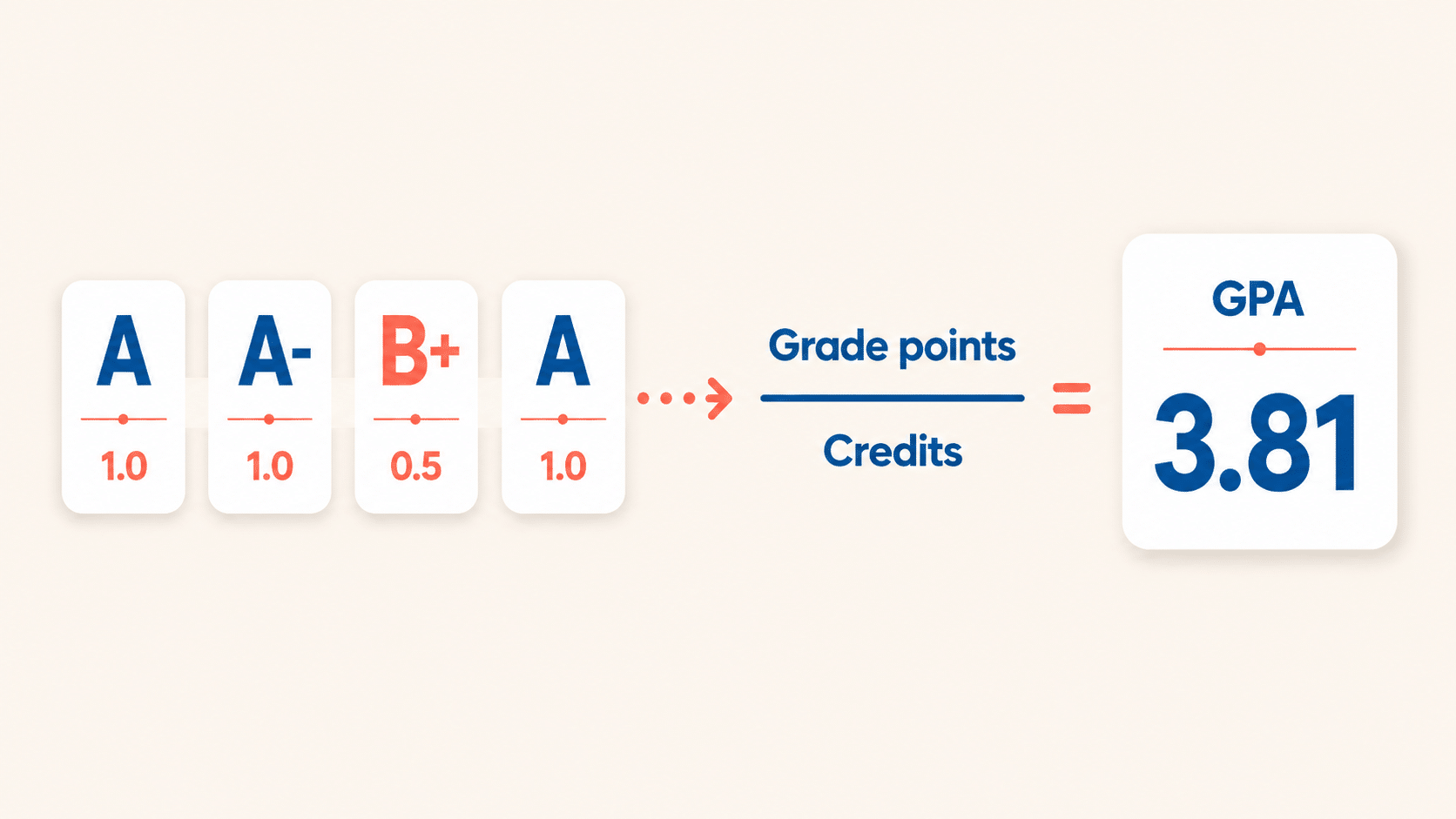
Quick answer
A homeschool GPA is a credit-weighted average, not a plain average of your grades. Convert each letter grade to grade points on a 4.0 scale, multiply by that course’s credit value, add it all up, then divide by total credits attempted. Honors courses add 0.5 and AP, IB or college-level courses add 1.0 to produce a weighted GPA alongside the unweighted one. Homeschool Reports does all of it for you as you type.
Can I guess how this went the first time? You made a spreadsheet. You added up the grade points, divided by the number of courses, and got a number that looked… fine. Then somebody mentioned credits, and weighted averages, and whether a semester of health class really counts the same as a full year of chemistry.
And the number stopped looking fine.
Calculating a homeschool GPA is genuinely simpler than the internet makes it sound — there is one formula and it fits on a napkin. But the details matter, because the whole point of a transcript is that someone else can read it and arrive at the same numbers you did. Let me walk you through it, and then show you the version where you never do the arithmetic again. You can follow along in a free Homeschool Reports account if you’d like.
What a homeschool GPA actually is
GPA stands for grade point average, and the word doing the quiet work in there is average. Not a total. Not a percentage. An average — but a weighted one, weighted by how much class time each course represents.
That last part is what most kitchen-table spreadsheets miss. A full-year chemistry course and a one-semester elective are not the same amount of work, so they should not carry the same amount of influence over one number that summarizes four years.
Here is the scale almost every school in the country works from. Yours should match it unless you have a specific reason to differ — and if you do differ, the transcript needs to say so.
| Grade | Percent | Grade points |
|---|---|---|
| A+ / A | 97–100 / 93–96 | 4.0 |
| A− | 90–92 | 3.7 |
| B+ / B / B− | 87–89 / 83–86 / 80–82 | 3.3 / 3.0 / 2.7 |
| C+ / C / C− | 77–79 / 73–76 / 70–72 | 2.3 / 2.0 / 1.7 |
| D+ / D / D− | 67–69 / 63–66 / 60–62 | 1.3 / 1.0 / 0.7 |
| F | below 60 | 0.0 |
The simple formula
Three steps. That is the whole of it.
- Convert each grade to pointsUse the table above. A B− in Algebra II becomes 2.7.
- Multiply by that course’s creditsA full-year course is usually 1.0 credit; a semester is 0.5. So 2.7 × 1.0 = 2.7 quality points.
- Divide the total by total credits attemptedAdd up every course’s quality points, add up every course’s credits, and divide the first by the second.
Worked through a single year, it looks like this:
| Course | Grade | Points | Credits | Quality points |
|---|---|---|---|---|
| English 10 | A− | 3.7 | 1.00 | 3.70 |
| Chemistry | B | 3.0 | 1.00 | 3.00 |
| Algebra II | B− | 2.7 | 1.00 | 2.70 |
| Health | A | 4.0 | 0.50 | 2.00 |
| Totals | 3.50 | 11.40 | ||
11.40 divided by 3.50 gives a GPA of 3.26.
Notice what happened to health class. It earned a perfect 4.0, but because it was half a credit it contributed half as much. Average the four letter grades the naive way and you get 3.35 — close enough to look right, wrong enough to be a different number than the one a registrar would calculate from the same table.
Rather not do this four years running? Let Homeschool Reports total it for you, free →
Weighted vs. unweighted GPA
Your transcript should carry both, and this trips up more families than the formula does.
Unweighted GPA
- Straight 4.0 scale
- No bonus for course difficulty
- Caps at 4.0
- The figure most admissions offices recalculate first
Weighted GPA
- Adds 0.5 for Honors
- Adds 1.0 for AP, IB and college-level
- Can exceed 4.0
- Shows that your student chose the harder road
Neither one is the “real” GPA. They answer different questions. Unweighted asks how well your student did; weighted asks how well they did given what they took on. A transcript that prints only the weighted number — especially one above 4.0 with no explanation — is the transcript that gets a phone call.

Print both numbers, label them, and print the rule that produces them. A reader should never have to guess which one they are looking at.
Handling honors and AP courses
The bonus applies to the grade points, before the credit multiplication. A B in an AP course is 3.0 + 1.0 = 4.0 quality points per credit.
- Honors: +0.5. Use it when the course genuinely went deeper or faster than the standard version.
- AP, IB and college-level: +1.0. Dual-enrollment courses at a community college count here.
- A failing grade gets no bonus. You do not earn credit for rigor you did not complete.
- Label the course type on the transcript. “AP Biology” in the course name, and the type in its own column.
- Don’t weight a course just because it was hard for your student.
- Don’t invent your own bonus values — 0.5 and 1.0 are what readers expect.
- Don’t weight every course. If everything is honors, nothing is.
Mom tip: if you are unsure whether a course earns the Honors label, ask whether you could describe the extra work in two sentences to an admissions reader. If yes, weight it. If you have to reach, don’t.

Let the GPA calculate itself
Enter the course, the grade and the credit value. Homeschool Reports handles the quality points, the weighting and the totals — and prints the grading scale on the transcript so anyone can check your numbers.
- Weighted and unweighted, side by side
- Year totals and cumulative GPA update as you type
- The full grading scale prints on every transcript
- No credit card required
- Free forever plan
- Set up in under 5 minutes
- Cancel any time
Where the math usually goes wrong
Four things account for nearly every GPA that does not reconcile.
Most of these start with grades that were never written down properly. A free report card template each term keeps the numbers in one place.
- Averaging the lettersThe most common one. Credits have to be the weights, or a semester elective sways the number as much as a year of math.
- Counting empty rowsA blank course line with a zero in it will quietly drag an average down. Only real courses belong in the calculation.
- Mixing scales mid-transcriptIf ninth grade used percentages and eleventh used letters, convert everything to one scale before you average.
- Forgetting attempted vs. earnedCredits attempted go in the denominator, including a course that was failed. Credits earned is a different figure and belongs elsewhere on the document.
Letting software do the math
You could keep doing this by hand. Plenty of families do, and the formula is not hard. But it has to be right four years in a row, across twenty-odd courses, while you are also teaching.
The spreadsheet years
- Rebuild the formula every August
- Hope the weighting is still correct
- Reformat the whole thing to print
- Recheck the totals at eleven at night
With Homeschool Reports
- Type the course, pick the grade and credit
- Totals update as you go
- Weighted and unweighted both printed
- Download the finished PDF
The part that matters most is not the convenience. It is that the finished transcript explains its own arithmetic: the thirteen-grade scale, the credit definition in clock hours, and the weighting rule all print on the document. Someone reading it can reproduce your GPA without contacting you — and that is what makes a homeschool transcript easy to work with.
Whatever you do, work heartily, as for the Lord and not for men.Colossians 3:23
Four years of faithful, unglamorous record-keeping is its own kind of diligence. It is also the thing that opens doors later. Do it a little at a time, and it never becomes a crisis.
Is a 4.0 the highest homeschool GPA possible?
Unweighted, yes — 4.0 is the ceiling. A weighted GPA can go above 4.0 because Honors adds 0.5 and AP, IB or college-level courses add 1.0 to the grade points before averaging.
How many credits should a homeschool transcript show?
Most students graduate with somewhere between 20 and 26 credits. One credit usually represents a full academic year in a subject — commonly 120 clock hours, 150 in Georgia, and often 180 for lab sciences.
Do I include middle school courses in the GPA?
Only high-school-level courses taken for high school credit. Algebra I or a world language completed in eighth grade can be included if it was genuinely high school work — list it under eighth grade so a reader can see what happened when.
What if my student failed a course and retook it?
Practice varies. The clearest approach is to show both attempts with their grades and count both in credits attempted, which is what a public high school transcript would do. Whatever you choose, apply it consistently across all four years.
Does the grading scale have to print on the transcript?
It is not universally required, but for a parent-issued transcript it is close to expected — a reader cannot look your school up in a directory. Printing the scale is what lets them verify your numbers, and it costs you nothing.
Simple pricing for homeschool families
Every plan includes every feature. Start free — upgrade only when you want watermark-free PDFs.
Starter
Free forever, every feature
$0Free for as long as you like
- Every report included
- Unlimited reports & records
- 1 child, upgrade anytime
Family
Single homeschool family
$39per year (or $9/mo)
- 5 Children + Add More
- Attendance Tracking
- Report Cards & Transcripts
School
Group, co-op, church or school
$149per year (or $49/mo)
- Unlimited children
- Everything in Family
- Manage multiple families
Build the transcript one year at a time
Add this year’s courses tonight and let the totals take care of themselves. Add next year when it comes. No August rebuild, no spreadsheet.
- Free plan, no credit card
- Weighted and unweighted GPA calculated for you
- Print-ready PDF whenever you need it
- No credit card required
- Free forever plan
- Set up in under 5 minutes
- Cancel any time