Homeschool Transcript
 Homeschool Reports9 min read
Quick answer
A homeschool transcript is a one-page official summary of your student’s high school years: the courses they took, the grades they earned, the credits those courses were worth, and their cumulative GPA. You write it yourself — as the administrator of your homeschool, you are the one authorized to issue it. Colleges, employers and military recruiters routinely work with parent-issued transcripts, though each sets its own policy — which is why what goes on the transcript matters so much.
If you have a high schooler at home, there is a good chance the word transcript has been sitting in the back of your mind for a while now. Maybe a college website asked for one. Maybe a grandparent asked how you’ll prove any of this counted. Either way, the question underneath is usually the same: am I allowed to make this myself, and will anyone take it seriously?
Yes, and yes. A homeschool transcript is not a document you have to request from someone else. It is a document you produce. And once you understand what belongs on it, it stops being intimidating and becomes what it actually is — a tidy summary of work your child has already done. You can start one free and fill it in as you go, which is far easier than reconstructing four years in one panicked weekend.
What goes on a homeschool transcript
Every transcript, homeschooled or not, is answering a small set of questions for whoever reads it. Get these on the page and you have a real transcript.
- Student and school identity — your student’s full legal name, date of birth, your homeschool’s name, and your address.
- Courses by year — grouped 9th, 10th, 11th, 12th, so a reader can see the progression.
- Grades — a letter or percentage for each course.
- Credits — usually 1.0 for a year-long course, 0.5 for a semester.
- Grading scale — a short key so an A is not ambiguous.
- Cumulative GPA — calculated from the grades and credits above.
- Graduation date and your signature.
- Test scores — PSAT, SAT or ACT, if your student has taken them.
That is the whole list. Notice what is not on it: lesson plans, curriculum brand names, attendance logs, portfolios, or an explanation of your teaching philosophy. Those things matter, and some states ask you to keep them, but they do not belong on the transcript itself. The transcript is the summary. Everything else is your supporting file.

How to create a homeschool transcript, step by step
- List every course by school yearGo year by year, not subject by subject. If your 10th grader did biology, algebra II, world literature, Spanish I, government and art, all six go under 10th grade.
- Give each course a credit valueThe common convention is one credit for a full year of study — roughly 120–180 hours of work — and half a credit for a semester. Be consistent across all four years.
- Assign a gradeUse whatever you genuinely used during the year: test averages, project scores, mastery, or your considered judgment as the teacher. Write it down while you still remember it.
- Publish your grading scaleState plainly what A, B and C meant in your homeschool. If you weighted honors or AP courses, say so.
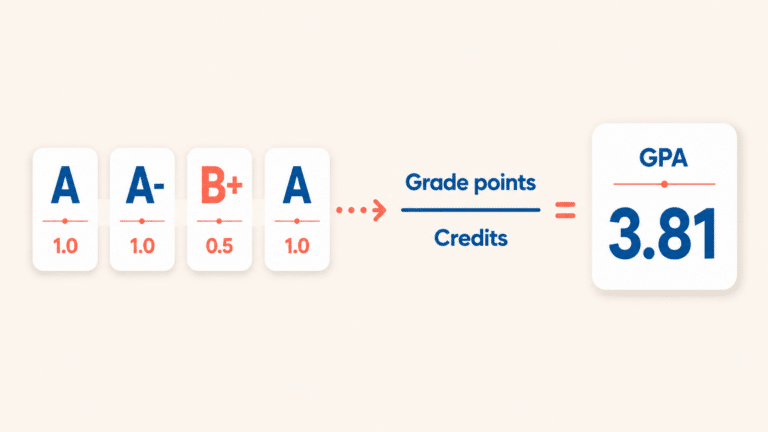
- Calculate the GPAMultiply each course’s grade points by its credits, add them up, divide by total credits. This is the step most people dread and the one worth automating.
- Add test scores and the graduation dateThen sign it. Your signature is what makes it official.
You are not asking permission to issue a transcript. As your homeschool’s administrator, you are the one who issues it.
Want the GPA math done for you as you type? Build your transcript free →
Credits and GPA without the spreadsheet headache
Here is where most families get stuck, so let’s make it concrete. On a standard 4.0 scale, an A is 4 points, a B is 3, a C is 2, a D is 1. Multiply the points by the credit value, total the column, and divide by the total credits attempted.
| Course | Grade | Points | Credits | Grade points |
|---|---|---|---|---|
| Algebra II | A | 4.0 | 1.0 | 4.0 |
| World Literature | B | 3.0 | 1.0 | 3.0 |
| Biology | A | 4.0 | 1.0 | 4.0 |
| Spanish I | B | 3.0 | 1.0 | 3.0 |
| Government | A | 4.0 | 0.5 | 2.0 |
| Total | 4.5 | 16.0 |
16.0 divided by 4.5 credits gives a 3.56 GPA. Straightforward for one year. Now do it across four years, twenty-odd courses, with half credits and a couple of weighted honors classes, in a spreadsheet you built in 2022 and haven’t opened since. That is the actual job, and it is why so many transcripts get started in the spring of senior year and finished in tears.
When you will actually need it
College applications
Nearly every application asks for a transcript. Most colleges have a homeschool applicant path and read parent-issued transcripts as a matter of course — a complete, clearly documented one gives them what they need to evaluate it.
Scholarships
Merit awards are usually decided on GPA and course rigor — both of which live on this page.
Employment
Employers verifying education want a document, not a description of your school year.
Military enlistment
Recruiters ask for proof of completed secondary education as part of the process.
Dual enrollment
Community colleges often want a current transcript before a high schooler enrolls.
Your own records
Ten years from now, you will not remember what your 9th grader read. The page will.
Requirements vary a great deal from one state to the next — some ask for very little, others expect records on a schedule. It is worth checking your state’s homeschool requirements once, early, rather than assuming. Your transcript is your own document either way, but knowing the local rules tells you what else to keep alongside it.
The hard version and the easy version
Either way, the transcript is only as good as the year-by-year grades behind it. Keeping those on a printable report card is enough to build from.
Building it by hand
- Reconstructing four years from memory and old notebooks
- GPA formulas you have to re-derive every time
- Formatting that never quite looks official
- One file, one laptop, no backup
- Rewriting the whole thing when you add a course
With Homeschool Reports
- Add courses year by year, as they happen
- GPA and credits calculated automatically
- A clean, professional layout every time
- Stored safely and reachable from anywhere
- Update once, reprint in seconds
The difference is not really the formatting. It is that one version asks you to remember four years at the worst possible moment, and the other asks you to spend two minutes at the end of each term.
Build your homeschool transcript before senior year gets loud
Add courses as you finish them, let the GPA calculate itself, and print a professional transcript whenever a college asks. No spreadsheet required.
- Courses, credits and GPA in one place
- Automatic GPA and test-score calculation
- Print or download a polished PDF any time
- No credit card required
- Free forever plan
- Set up in under 5 minutes
- Cancel any time
A few things that make a transcript stronger
- Use recognizable course names. “American Literature” travels better than “Mom’s Reading List, Year 3.”
- Keep it to one page. Admissions officers skim. One clean page reads as competent.
- Include the grading scale. It answers a question before it gets asked.
- Note dual enrollment and outside classes. Co-op, community college and online courses all count — label the provider.
- Keep supporting records separately. Reading lists, portfolios and attendance records back up the transcript without cluttering it.
- Don’t inflate grades. A tidy, honest 3.4 is more credible than a suspicious 4.0.
- Don’t leave the graduation date blank — it is one of the first things a reader looks for.
- Don’t wait until spring of senior year. Please.
“Whatever you do, work heartily, as for the Lord and not for men.”
Colossians 3:23
Recording your child’s work carefully is part of that. Not because a college requires it, but because four years of faithful effort deserve to be written down properly — and because handing your graduate a document with their name on it says something a spreadsheet never will.
Homeschool transcript questions, answered
Who is allowed to issue a homeschool transcript?
You are. As the administrator of your homeschool you are the person who issues it, and in most states it does not need to be notarized or approved by a school district. A small number of colleges do ask for notarization — check the ones your student is applying to. Colleges and employers work with parent-issued transcripts routinely; none of them are obliged to, so the goal is a record that answers their questions before they ask.
Do I need to be accredited?
No. Accreditation is optional and most homeschool families do not pursue it. A small number of programs or scholarships may ask for it — check with the specific institution rather than assuming. Here is what accreditation actually means, and the one case where it matters.
What if we didn’t give letter grades?
Assign them retroactively based on the work your student actually did, and explain your scale on the transcript. Mastery-based and narrative approaches translate to letters more easily than you would expect.
How many credits does a high schooler need?
Expectations differ by state and by the colleges your student is applying to — commonly in the low-to-mid twenties across four years. Check your state’s rules and the requirements of two or three target schools, then plan backwards.
Can I add courses after I have printed it?
Yes. A transcript is a living record until graduation. Update it and reprint — which is a great deal easier when it is not a hand-built spreadsheet.
What it costs
You can build and keep your records for free, and only pay if you want more students and unwatermarked downloads.
Simple pricing for homeschool families
Every plan includes every feature. Start free — upgrade only when you want watermark-free PDFs.
Starter
Free forever, every feature
$0Free for as long as you like
- Every report included
- Unlimited reports & records
- 1 child, upgrade anytime
Family
Single homeschool family
$39per year (or $9/mo)
- 5 Children + Add More
- Attendance Tracking
- Report Cards & Transcripts
School
Group, co-op, church or school
$149per year (or $49/mo)
- Unlimited children
- Everything in Family
- Manage multiple families
Start your student's transcript today
It takes a few minutes now and saves you a very long weekend later. Add what you have, and build it out as the years go.
- Free to start, no credit card
- Transcripts, report cards and attendance in one place
- Print a professional PDF whenever you need it
- No credit card required
- Free forever plan
- Set up in under 5 minutes
- Cancel any time