Homeschool Diploma
 Homeschool Reports8 min read
Quick answer
A homeschool diploma is the document you issue to your own graduate certifying that they completed high school at home. You are the administrator of your homeschool, so you are the one who signs it — no school district, state agency or accreditor has to approve it. It carries the student’s name, your homeschool’s name, the graduation date and your signature.
There is a moment near the end of senior year when a homeschool mom realises nobody is going to hand her child a diploma. There’s no auditorium, no principal, no envelope. If your graduate is going to hold one, you are the person who makes it. That can feel presumptuous the first time you think about it. It isn’t. It’s simply how homeschooling works, and it has been for decades.
A homeschool diploma is a real document with real weight, and producing one takes minutes rather than an afternoon of wrestling with a word processor. You can make one free and print it on whatever paper you like.
What a homeschool diploma actually is
It is a certificate of completion issued by the school that taught the student. In your case, that school is your home, and you are its administrator. That is the entire legal mechanism, and it is the same one a private school uses.
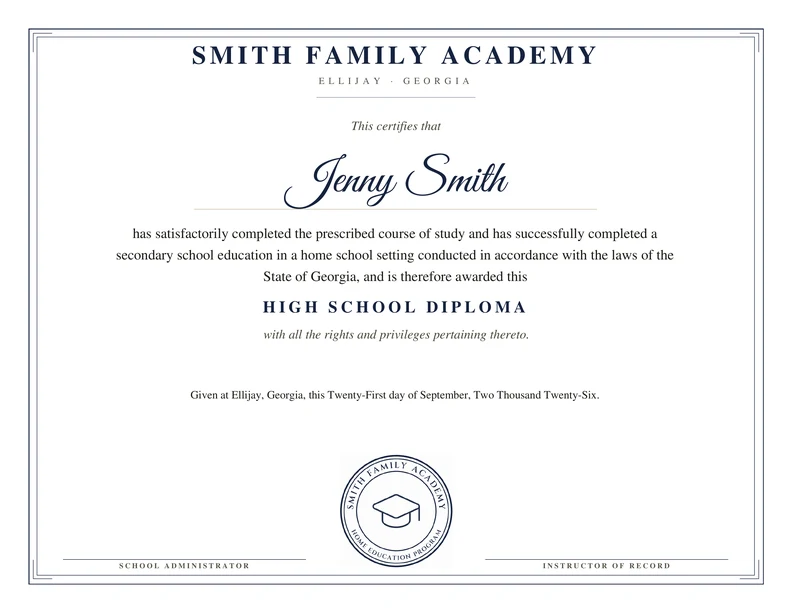
- Student’s full legal name — exactly as it appears on official documents.
- Your homeschool’s name — e.g. “Smith Family Academy.”
- A statement of completion — that the student has satisfied the requirements for graduation.
- The graduation date.
- The administrator’s signature — yours.
- Optionally a seal, a second signature, or your state’s name.
You are not printing a substitute for a diploma. You are printing the diploma.
Will anyone accept it?
This is the real question underneath, so let’s answer it directly rather than reassuringly.
Colleges
Admissions offices are thoroughly used to homeschool applicants. Most weigh the transcript and test scores more heavily than the diploma itself.
Employers
A parent-issued diploma satisfies a “high school diploma required” line in the overwhelming majority of cases.
The military
Each branch sets its own policy and it has changed over the years. If enlistment is the plan, ask a recruiter early rather than at the end of senior year.
The honest summary: the diploma is the ceremonial document and the transcript is the evidentiary one. Both matter. If someone is going to scrutinise anything, it will be the transcript — which is a good argument for keeping it properly all along rather than assembling it in a panic.
Building the whole graduation file at once? Start free →
Do you need to be accredited?
No. Accreditation is a voluntary process that applies to schools, and the large majority of homeschool families never pursue it. A homeschool diploma from an unaccredited home school is still a homeschool diploma.
What varies is state law about homeschooling itself — notification, testing, record-keeping — and that is worth reading once. Check your state’s homeschool requirements before senior year rather than during it. A handful of states have specific language about graduation; most simply leave it to the parent.
The hard version and the easy version
Either way, keep the grades behind it. A free report card template each term is all the paperwork a diploma really rests on.
Making one from scratch
- Hunting for a template that doesn’t look like a certificate of participation
- Fighting margins and fonts in a word processor
- Text that shifts every time you fix a typo
- Printing three times to get it centred
With Homeschool Reports
- Enter the names and the date
- A designed, properly typeset diploma
- Download a print-ready PDF
- Reprint free if you want a spare for the grandparents
Print your graduate's diploma this week
Enter their name, your homeschool's name and the graduation date. Download a properly designed, print-ready diploma in minutes.
- Professionally typeset, not a word-processor template
- Print at home or at a print shop
- Reprint any time, free
- No credit card required
- Free forever plan
- Set up in under 5 minutes
- Cancel any time
Making the day feel like a graduation
- Print on heavier stock. 65–110 lb cardstock changes how it feels in the hand entirely.
- Buy a frame or a cover. Diploma covers are inexpensive and make the presentation.
- Have someone read it aloud. Dad, a grandparent, a co-op leader. Say the whole name.
- Print two. One to keep flat in a file, one to hang.
- Pair it with the transcript. The diploma is for the wall; the transcript is what actually gets mailed.
“Train up a child in the way he should go; even when he is old he will not depart from it.”
Proverbs 22:6
Twelve years of kitchen-table mornings, read-alouds, spilled science experiments and a great many days you weren’t sure you were doing it right. The diploma doesn’t capture any of that. But it does say, in ink, that it happened and that it was finished well.
Homeschool diploma questions, answered
Is a homeschool diploma legal?
Yes. As the administrator of your homeschool you are the issuing authority, exactly as a private school administrator is for their students. No external approval is required.
Should my student get a GED instead?
Generally no. A GED is an equivalency exam for people who did not complete high school — your student did. Some institutions view a GED less favourably, so only consider it if a specific program you are targeting requires one.
What name should I put as the school?
Whatever you have used consistently on your other records — ideally the same name that appears on the transcript. Consistency across documents matters more than the name itself.
Does it need a seal or a notary?
No. A seal is decorative. Notarisation is not required, though a few families choose it for peace of mind.
When should I date it?
The date your student completed their final requirements, or your ceremony date. Keep it consistent with the graduation date on the transcript.
Diploma, transcript, or certificate — which is which
Three documents get confused constantly, and knowing the difference saves a lot of second-guessing.
| Document | What it says | Who asks for it |
|---|---|---|
| Diploma | This student completed high school. | Employers, the wall, the ceremony |
| Transcript | Here is exactly what they studied and how they did. | Colleges, scholarships, dual enrollment |
| Certificate of completion | This student finished a program or a course of study. | Co-ops, specific programs, milestone recognition |
If you only produce one, produce the transcript — it does the heavy lifting. But the diploma is the one your graduate will still have on a shelf in twenty years, and it costs you almost nothing to make properly.
When the path wasn’t standard
Most homeschool graduations aren’t tidy, and that is fine. A few common situations and what to do:
- Graduating earlyPlenty of homeschoolers finish at sixteen or seventeen. Date the diploma when the work was actually completed. If they will enrol somewhere that expects an eighteen-year-old, the transcript is what explains the timeline.
- Dual enrollment along the wayCollege credit earned in high school still sits on the high school transcript, labelled with the provider. The diploma doesn’t change.
- A student with learning differencesYou set the graduation requirements for your homeschool. If your student met the standard you set for them, they graduated. Do not invent a lesser document.
- Finishing mid-yearUse the real completion date rather than forcing it to a June ceremony date. Consistency with the transcript matters more than tidiness.
- Coming home late in high schoolIf your student did ninth and tenth grade elsewhere, request those records, fold them into your transcript with the school named, and issue the diploma yourself for the years you administered.
In every one of these cases the principle is the same: you set the requirements, you assess whether they were met, and you certify the result. That authority is not something you have to justify to anyone in advance.
Mistakes worth avoiding
- Using a different homeschool name than the transcript. The two documents get read together. If one says “Smith Family Academy” and the other says “The Smith Homeschool,” you have created a question that did not need to exist.
- Leaving the signature line blank. An unsigned diploma is a printout. Sign it in ink, on the copy you hand over.
- Abbreviating your student’s name. Use the full legal name, matching their birth certificate and their transcript.
- Printing on ordinary paper. It costs a few dollars to do this properly once.
- Waiting until the week of the ceremony. Print it early, check the spelling twice, and put it somewhere flat.
None of these are catastrophic and every one of them is avoidable in about five minutes of care. The document is going to outlive the ceremony by decades — it is worth getting the small things right.
What it costs
Start free, and upgrade only if you want more students and unwatermarked downloads.
Simple pricing for homeschool families
Every plan includes every feature. Start free — upgrade only when you want watermark-free PDFs.
Starter
Free forever, every feature
$0Free for as long as you like
- Every report included
- Unlimited reports & records
- 1 child, upgrade anytime
Family
Single homeschool family
$39per year (or $9/mo)
- 5 Children + Add More
- Attendance Tracking
- Report Cards & Transcripts
School
Group, co-op, church or school
$149per year (or $49/mo)
- Unlimited children
- Everything in Family
- Manage multiple families
Give your graduate something to hold
Their name, your homeschool, the date and your signature — properly designed and ready to print.
- Free to start, no credit card
- Diplomas, transcripts and report cards in one place
- Print-ready PDF, reprint any time
- No credit card required
- Free forever plan
- Set up in under 5 minutes
- Cancel any time