How to Get a Homeschool Diploma
 Homeschool Reports9 min read
Quick answer
To get a homeschool diploma, you issue it yourself. Decide your graduation requirements, keep a transcript as your student works through them, confirm the requirements are met, then print and sign a diploma naming your student, your homeschool and the graduation date. No district, agency or accreditor has to approve it.
Most families arrive at this question backwards. They search for how to get a homeschool diploma expecting to find an office to apply to, a form to submit, a body that grants it. There isn’t one, and that is not a gap in the system — it is the system. You have been the school for twelve years. You are also the one who certifies the finish.
That surprises people, and occasionally worries them. It shouldn’t. Private schools issue their own diplomas on exactly the same basis, and homeschool graduates go to college, get hired and enlist every year. What follows is the whole process in order, including the parts people skip and later regret. If you would rather have the paperwork keep itself as you go, you can start free and build the transcript and diploma together.
How to get a homeschool diploma, step by step
- Set your graduation requirements — ideally in ninth gradeDecide how many credits your homeschool requires and in what subjects. A common shape is four years of English, three to four of math, three of science, three of social studies, two of a foreign language, plus electives. Write it down once. It becomes the standard you are certifying against.
- Check your state’s rulesA few states have specific language about homeschool graduation or require notification through the final year. Most leave it entirely to the parent. Read your state’s homeschool requirements early rather than in May of senior year.
- Keep the transcript as you goCourse, grade, credit, year — entered as each course finishes. This is the step that determines whether senior spring is calm or awful.
- Keep attendance alongside itWhere your state requires it, an attendance record supports everything else and takes seconds a week.
- Confirm the requirements are actually metSit down at the start of senior year with your own list and the transcript side by side. If something is short, there is still a year to fix it. This is the single most valuable hour in the process.
- Choose the graduation dateThe date the final requirement was completed, or your ceremony date. Use the same date on the diploma and the transcript.
- Produce and sign the diplomaStudent’s full legal name, your homeschool’s name, a statement of completion, the date, and your signature in ink.
There is no authority to apply to. You set the standard, you assess whether it was met, and you certify the result.
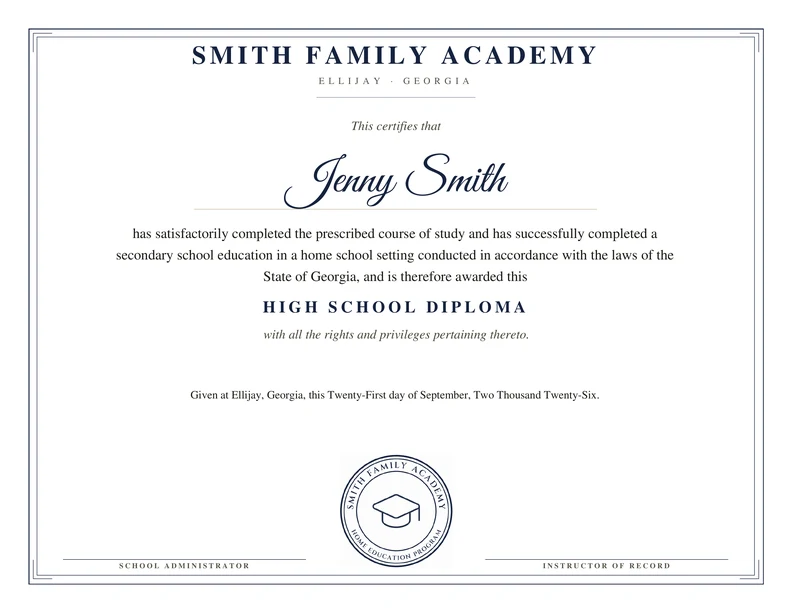
Want the transcript and diploma built in the same place? Start free →
Setting requirements you can actually certify
“Graduation requirements” sounds institutional, but all it means is: what does finishing look like in this house? Write it down and you have something to measure against instead of a feeling.
| Subject | Typical credits | Notes |
|---|---|---|
| English | 4 | Literature and composition each year |
| Mathematics | 3–4 | Through Algebra II is a common floor |
| Science | 3 | At least one with a lab component |
| Social studies | 3 | Usually including US history and government |
| Foreign language | 2 | Same language, two consecutive years |
| Fine arts / PE / electives | 4–6 | Where the individual student shows up |
That is a guideline, not a law. If your student is heading to a selective college, look up two or three target schools’ stated expectations and plan to those instead — they are published, and they are usually more demanding than a generic list. If your student is heading into a trade, weight the electives accordingly and say so plainly on the transcript. A homeschool transcript that reflects a real, deliberate path reads better than one that imitates a public school badly.
What colleges actually look at
The diploma is rarely the deciding document. Admissions offices are looking at a bundle, and it helps to know the order of importance.
The transcript
Course rigor, grades and credits. This does most of the work.
Test scores
Still requested by many schools for homeschool applicants specifically.
Course descriptions
Some schools ask for a short paragraph per course. Easier to write as you go.
The diploma
Usually a formality — but conspicuous by its absence.
Two practical consequences. First, protect the transcript above everything else. Second, if a college’s homeschool page asks for something specific — a portfolio, course descriptions, a parent letter — find that out in junior year, because those are far easier to assemble while the courses are fresh.
The mistakes that cost people time
- Starting the transcript in senior year. Reconstructing four years from memory is the worst job in homeschooling, and it is entirely optional.
- Discovering a missing credit in April. The senior-year audit exists to prevent exactly this.
- Different names on different documents. Your homeschool’s name must match across the diploma, the transcript and anything you have filed with the state.
- Assuming the military accepts it without asking. Policies differ by branch and have changed over the years. Ask a recruiter in junior year, not after graduation.
- Reaching for a GED reflexively. A GED is an equivalency for people who did not finish. Your student finished.
Doing it by hand versus keeping it as you go
A diploma is the last page of a paper trail that starts years earlier. If you are keeping that trail by hand, the free printable report card templates are a good place to begin.
The senior-spring scramble
- Four years of courses reconstructed from memory
- GPA recalculated three times, differently
- A diploma fought out in a word processor
- Deadlines arriving while you format margins
Keeping it current
- Courses entered as each one finishes
- GPA and credits calculated automatically
- Diploma generated from the same records
- Senior year spent on the student, not the paperwork
Get the diploma without the senior-spring scramble
Keep the transcript current as your student works, audit it once at the start of senior year, and print a properly designed diploma when they finish.
- Courses, credits and GPA in one place
- Diploma and transcript from the same records
- Print-ready PDFs, reprint any time
- No credit card required
- Free forever plan
- Set up in under 5 minutes
- Cancel any time
What to do in each high school year
- 9th gradeWrite your graduation requirements. Start the transcript with the very first course.
- 10th gradeKeep entering courses. Consider PSAT practice. Note any outside classes with their provider.
- 11th gradeTake the PSAT/SAT/ACT if college is likely. If the military is on the table, talk to a recruiter now. Check credits against your own list.
- 12th grade, fallAudit the transcript against your requirements. Fix any shortfall while there is time. Send transcripts with applications.
- 12th grade, springConfirm final grades, set the graduation date, print and sign the diploma.
What to keep after graduation
- The transcript, indefinitely. It gets requested years later — for transfers, graduate programs, licensing and occasionally employment.
- A spare diploma. Print two while the file is open. One to hang, one to keep flat.
- Course descriptions, if you wrote them. Some colleges ask after admission as well as before.
- Test score reports. Keep the originals; re-requesting them later costs money and time.
- A copy off-site. Cloud storage or a relative’s cabinet. Records lost in a house fire cannot be reconstructed.
“Let us not grow weary of doing good, for in due season we will reap, if we do not give up.”
Galatians 6:9
Four years is a long season, and most of it is unglamorous. The paperwork at the end is not the achievement — it is just the receipt. But it is worth producing carefully, because it is the part your student gets to keep.
One last encouragement. Nearly every homeschool parent doubts, at some point in the final year, whether they were qualified to do any of this. The paperwork will not answer that question, and it was never the point. Your student learned to read at your table, argued about history in your car, and finished. Sign the diploma with a steady hand.
Questions families ask
Who issues a homeschool diploma?
You do, as the administrator of your homeschool. It is the same mechanism a private school uses for its own students.
Do I need to be accredited to issue one?
No. Accreditation is voluntary and most homeschool families do not pursue it.
How many credits does my student need?
Whatever your homeschool requires — commonly in the low-to-mid twenties. If specific colleges are the goal, use their published expectations as your floor.
Can I buy a homeschool diploma from an online school instead?
You can enrol in an umbrella or online program that issues one, and some families prefer that. It is not required, and it does not make the document more valid than one you issue yourself.
What if we started homeschooling in eleventh grade?
Request records from the previous school, include those courses on your transcript with the school named, and issue the diploma for the program you administered.
What it costs
Start free and keep your records as long as you like. Upgrade only when you want more students and unwatermarked downloads.
Simple pricing for homeschool families
Every plan includes every feature. Start free — upgrade only when you want watermark-free PDFs.
Starter
Free forever, every feature
$0Free for as long as you like
- Every report included
- Unlimited reports & records
- 1 child, upgrade anytime
Family
Single homeschool family
$39per year (or $9/mo)
- 5 Children + Add More
- Attendance Tracking
- Report Cards & Transcripts
School
Group, co-op, church or school
$149per year (or $49/mo)
- Unlimited children
- Everything in Family
- Manage multiple families
Build the records now, print the diploma later
Whether your student is in ninth grade or twelfth, the fix is the same: get the transcript current and keep it that way.
- Free to start, no credit card
- Transcripts, diplomas, report cards and attendance together
- Print-ready PDFs whenever you need them
- No credit card required
- Free forever plan
- Set up in under 5 minutes
- Cancel any time