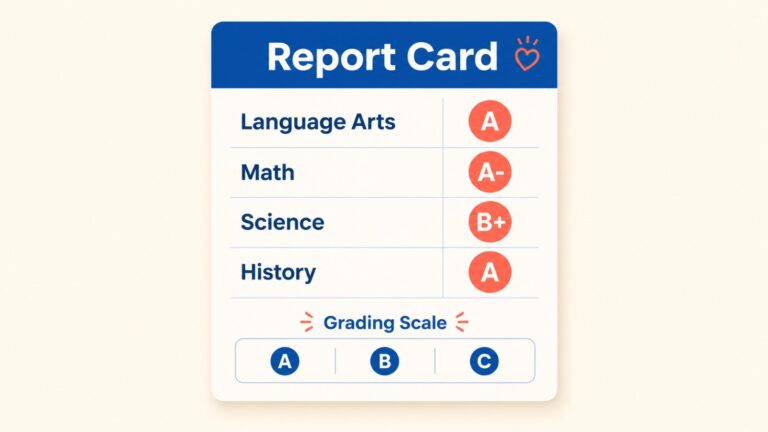
How to Create a Homeschool Report Card
 Homeschool Reports9 min read
Quick answer
To create a homeschool report card, list each subject your student studied this term, assign a grade using a scale you define, add attendance and any comments, then print and sign it. You are the teacher of record, so the grades are yours to give — and a report card is the simplest way to make a term’s work visible to your student, your family and, if it ever comes up, your state.
Report cards are the record most homeschool families skip, and the one that pays off soonest. Not because anyone is likely to demand one, but because they turn a fog of “we did some math and read a lot” into something specific. Your student sees it. Grandparents see it. And four years later, when you are building a transcript, you are reading your own report cards instead of trying to remember 10th grade.
Making one is not hard. Making one consistently is the part that takes a system, and you can start free if you would rather not rebuild the layout every term.
How to create a homeschool report card, step by step
- Decide your grading periodQuarters, trimesters, semesters or once a year. Whatever you choose, keep it the same across children and across years so the records compare.
- List the subjectsUse names a stranger would recognise — “Language Arts,” “Pre-Algebra,” “US History” rather than the curriculum’s brand name.
- Choose a grading scale and write it on the cardTraditional letters, percentages, or standards-based marks like E/G/S/N. Any of them is fine. An unexplained scale is not.
- Assign the gradesTest averages, completed work, mastery, your own considered judgment as the teacher — or a blend. You know how the term went.
- Add attendanceDays schooled this period, pulled from your attendance record.
- Write a short commentTwo or three sentences. This is the part your student will actually read.
- Sign, date, print, fileOne copy for the file, one for the fridge.
You are the teacher of record. The grades are yours to give, and nobody has to countersign them.

Want the layout handled for you? Print your first report card free →
Choosing a grading scale
This is the decision families agonise over, so here is a straight comparison.
| Scale | Looks like | Best when |
|---|---|---|
| Letter grades | A, B, C, D, F | High school, or anywhere a transcript will follow |
| Percentages | 93%, 87% | You are grading discrete work and want precision |
| Standards-based | E / G / S / P / N / U | Elementary years, or mastery-focused teaching |
| Narrative | A paragraph per subject | Early years, or a child for whom a letter would mislead |
A practical middle path: standards-based marks through elementary, letter grades from about seventh grade, and letters plus percentages in high school where the transcript needs them. Whatever you pick, print the key on the card. A reader who does not know what “S” means will assume the worst.
How to grade honestly when you are also the parent
This is the genuinely hard part, and no template solves it. Three things help.
Decide the standard first
Before the term, not after. “An A means mastered independently” is a standard. “An A means she tried hard” is a feeling.
Keep something to grade from
A few scores, a portfolio, a checklist. Anything beats grading a whole term from memory in one sitting.
Use the comment for the effort
Let the grade describe the work and the comment describe the child. That way you can be honest twice.
Grade inflation is the common failure, and it costs your student more than it protects them. A transcript of straight As with modest test scores raises questions; a transcript with an honest B in the subject they found hard, and an A in the one they love, tells a true and far more persuasive story.
What to write in the comments
- Name one specific thing they did well. “Read all of The Hobbit aloud to her brother” beats “good progress in reading.”
- Name one thing to work on, plainly and kindly. Children can tell when a report card is only flattery.
- Say what comes next term. It turns the card from a verdict into a plan.
- Keep it to three or four sentences. Long comments get skimmed.
- Don’t compare siblings on a report card. Ever.
- Don’t use it to relitigate a difficult term. Say it in person instead.
- Don’t leave it blank — the comment is the part with the most value per minute.
Doing it by hand versus keeping a system
By hand is a real choice, and it works. If that is yours, start with the free printable report card templates. There is one for each stage, and nothing to sign up for.
Rebuilding it every term
- Hunting for last term’s file
- Re-typing the subject list from scratch
- A layout that shifts every time you add a row
- Cards for three children in three different formats
- Nothing to hand to the transcript in four years
With Homeschool Reports
- Subjects carried forward term to term
- A consistent, professional layout every time
- Attendance pulled in automatically
- Every child, same format
- A run of report cards the transcript can be built from
Print a report card before this term ends
List the subjects, choose your scale, add a comment, and download a clean report card. Then do the next one in five minutes because the subjects are already there.
- Consistent layout across children and terms
- Attendance and grading scale included
- Print-ready PDF, reprint any time
- No credit card required
- Free forever plan
- Set up in under 5 minutes
- Cancel any time
How report cards feed the transcript
- ElementaryReport cards are mostly for your student and your own records. Keep them; they are pleasant to reread.
- Middle schoolStart using letter grades and recognisable subject names. High-school-level courses taken early can count later.
- 9th–11th gradeEach term’s card becomes a line on the transcript. Do this as you go and the transcript writes itself.
- 12th gradeFinal grades close out the transcript, which goes with applications alongside the diploma.
That progression is the real argument for report cards. On their own they are a nice ritual. Kept consistently, they are the raw material for every high-school document you will eventually need, and they mean you never have to reconstruct a grade you cannot honestly remember.
“Whatever you do, work heartily, as for the Lord and not for men.”
Colossians 3:23
A report card is a small way of saying that this term’s work counted and somebody was paying attention. That is worth doing carefully, even in a house where nobody is going to check.
What belongs on the card — and what doesn’t
A report card is a summary, not a portfolio. Keeping it tight is what makes it readable and what makes it fast enough that you will actually produce the next one.
Leave off the card
- Curriculum brand names and edition numbers
- Lesson-by-lesson detail
- Reading lists and book logs
- Your teaching philosophy
- Anything about a sibling
Keep on the card
- Subject, grade, grading scale key
- Days attended this period
- A short teacher comment
- Student name, homeschool name, term
- Your signature and the date
Everything on the left is worth keeping — just keep it in the file behind the card, not on it. If someone wants the reading list, they will ask, and you will have it.
Common questions about grading a term you’re unsure about
Some terms do not go to plan. Illness, a move, a new baby, a subject that quietly fell apart in February. Report cards handle this better than people expect.
- Grade the work that happenedIf you covered two thirds of the math book, grade the two thirds. Note the scope in the comment rather than inventing a mark for material nobody taught.
- Use “in progress” where it is honestA course that carries into next term can say so. That is normal in schools too.
- Don’t punish the child for the termA hard year is usually the adult’s circumstances, not the student’s effort. Grade the learning; explain the context in the comment.
- Write the comment last, and generouslyIt is the part they will remember. Truthful and kind are not in conflict.
- Then move onA recorded imperfect term is worth far more than a missing one.
The families who keep the best records are not the ones who had the smoothest years. They are the ones who kept writing things down anyway.
Report card questions, answered
Do homeschoolers have to give report cards?
In most states, no. A minority require periodic assessment or reporting. Check your state’s homeschool requirements — but many families keep them regardless, because of what they do for the transcript.
What grade should I give if we didn’t finish the curriculum?
Grade what was actually covered, and note the scope in the comment. Finishing a book is not the same as mastering a subject, and a report card can say so.
Can I use standards-based marks in high school?
You can, but letter grades convert to a GPA and standards-based marks do not. If a transcript is coming, letters will save you a conversion later.
How often should I make one?
Quarterly is common and manageable. Twice a year is plenty for elementary. Once a year is the minimum that still helps the transcript.
Should my student see it?
Yes — that is most of the point. Hand it over, read the comment together, and let them keep a copy.
What it costs
Start free and keep your records as long as you like. Upgrade only when you want more students and unwatermarked downloads.
Simple pricing for homeschool families
Every plan includes every feature. Start free — upgrade only when you want watermark-free PDFs.
Starter
Free forever, every feature
$0Free for as long as you like
- Every report included
- Unlimited reports & records
- 1 child, upgrade anytime
Family
Single homeschool family
$39per year (or $9/mo)
- 5 Children + Add More
- Attendance Tracking
- Report Cards & Transcripts
School
Group, co-op, church or school
$149per year (or $49/mo)
- Unlimited children
- Everything in Family
- Manage multiple families
Make this term count on paper
One card now, and the next one takes five minutes. Four years of them and the transcript is already written.
- Free to start, no credit card
- Report cards, attendance and transcripts together
- Print-ready PDF whenever you need it
- No credit card required
- Free forever plan
- Set up in under 5 minutes
- Cancel any time