
How to Make Homeschooling Fun Again (When It Feels Like a Grind)
 Homeschool Reports7 min read
Somewhere between the third spelling list and the fourth “Do I have to?”, the sparkle can slip out of your homeschool. If mornings feel more like a slog than a gift, you are not failing — you are just tired. The good news? Learning how to make homeschooling fun again is usually less about a total overhaul and more about a few small, doable shifts. Joy is closer than you think.
Let’s talk honestly about why the grind creeps in, and then walk through simple ways to bring the laughter, curiosity, and delight back to your days — without adding one more thing to your already-full plate.
The heart of it
A fun homeschool isn’t one with more crafts or a prettier schedule. It’s one where you and your kids feel free to enjoy the learning — and each other — again.
Why the joy fades
Nobody starts homeschooling hoping to dread it. But somewhere along the way, the pressure builds. You compare your family to the highlight reels online. You worry you’re “behind.” You white-knuckle your way through curriculum that isn’t fitting, because quitting feels like failing.
Here are the usual joy-thieves worth naming:
- Doing too much. An overstuffed schedule leaves no margin for wonder. When every minute is booked, curiosity has nowhere to breathe.
- The wrong fit. A program that’s too advanced, too babyish, or just too dry for your child turns every lesson into a battle.
- Isolation and fatigue. You’re the teacher, the principal, the lunch lady, and the janitor. Burnout is real, and it steals delight quietly.
- Losing the “why.” When you forget the freedom and closeness that drew you to homeschooling, the daily tasks feel like a treadmill.
If any of those hit home, take a breath. Naming the grind is the first step out of it. You don’t need to be a more energetic, Pinterest-perfect mom. You just need permission to make a few changes — starting today.
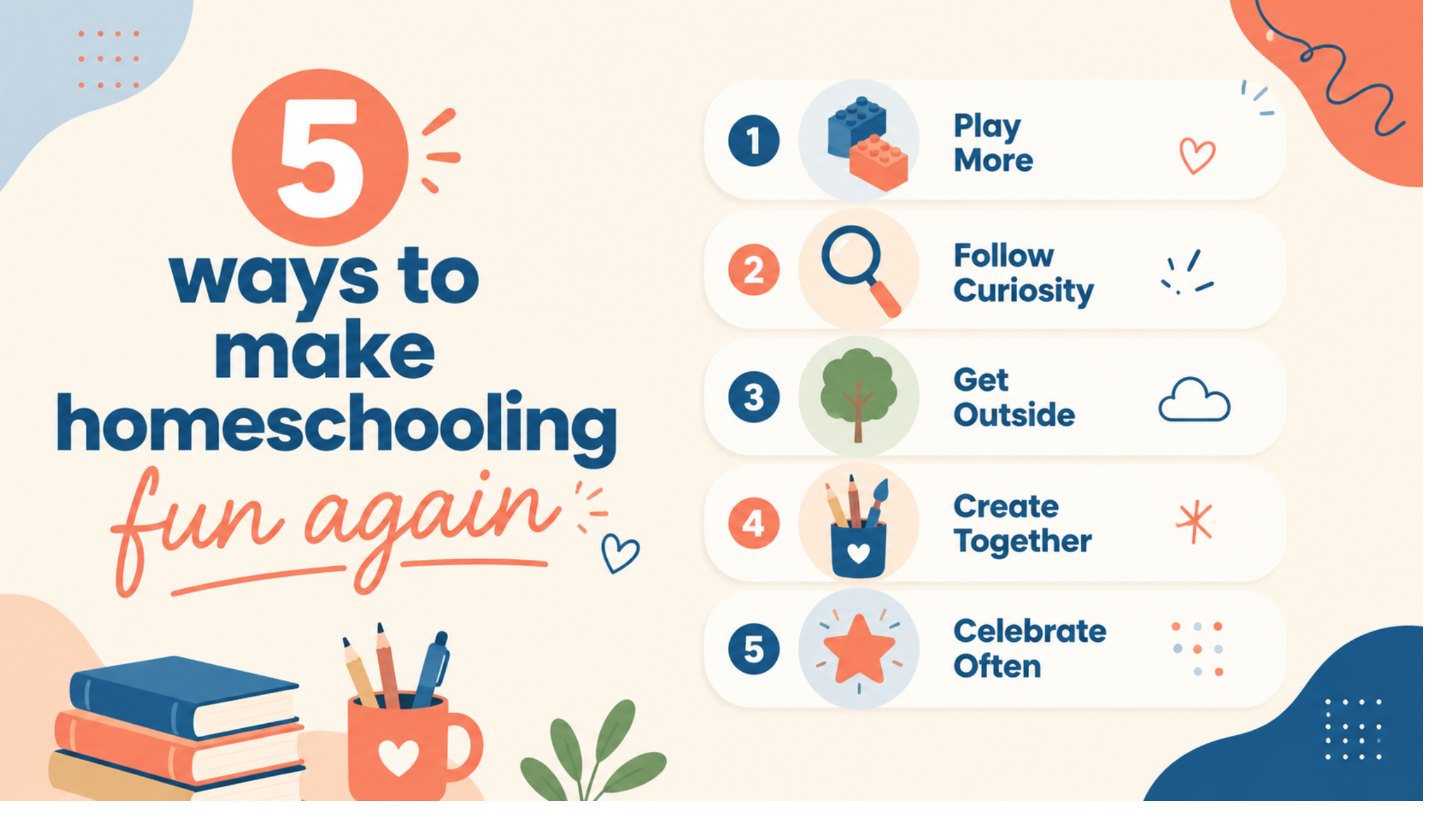
Add play back in
Play isn’t the reward you earn after “real” school. For kids, play is how real learning sticks. One of the fastest ways to make homeschooling fun again is simply to let more of it back in.
Try weaving these into your week without overhauling anything:
- Turn drills into games. Spelling with sidewalk chalk. Math facts with a beach ball toss. Grammar as “detective work.” The content is identical — the delivery is playful.
- Use songs and movement. Kids remember what they sing and do far better than what they merely copy. Music and hands-on activities are some of the stickiest teaching tools there are, which is exactly why so many of our homeschool curriculum resources are built around songs, games, and movement.
- Build in a “yes” activity. Once a week, let a child choose how you learn something — a puppet show, a baking-as-fractions morning, a nature scavenger hunt. Ownership brings energy.
Mom tip
Start with just one subject your child dislikes most, and make only that one playful this week. Small wins build momentum — you don’t have to gamify everything at once.
You’ll often find that when the fun returns, the resistance melts. A giggling kid learns more in ten minutes than a grumpy one does in an hour.
Follow rabbit trails
Some of the richest fun homeschool ideas aren’t planned at all. They start with a question: “Why is the sky blue?” “How do volcanoes work?” “What did knights actually eat?” That spark of curiosity is pure gold — and one of the greatest gifts of homeschooling is that you’re allowed to chase it.
Following a rabbit trail simply means setting the checklist aside for an afternoon and diving into whatever has captured your child’s imagination. Watch the documentary. Check out five library books on dinosaurs. Let the science lesson become a two-hour kitchen experiment.
You are not “getting behind” when you do this. You are teaching your child that learning is delightful, that their questions matter, and that the world is worth exploring. That lesson outlasts any worksheet.
There’s real freedom in remembering that you get to delight in your children the way God delights in you — not managing them through a curriculum, but walking alongside them as they discover His world. When you slow down enough to enjoy their wonder, homeschool stops feeling like a grind and starts feeling like the relationship it was always meant to be.
Change the scenery
Sometimes the fastest route to homeschool joy isn’t a new method — it’s a new location. The same lesson that felt heavy at the kitchen table can feel like an adventure on a picnic blanket.
When the walls start closing in, try:
- School outside. Read on the porch, do math on the driveway with chalk, take science to the backyard.
- Go mobile. A library, a coffee shop, a grandparent’s house, or a park bench can reset everyone’s mood.
- Make a “field trip Friday.” A museum, a farm, a nature preserve, or even the grocery store (hello, budgeting and nutrition) counts as school — and it counts as fun.
- Rearrange your space. If leaving isn’t doable, a cozy reading nook, a fresh wall of the kids’ artwork, or simply clearing the clutter can lift the whole room.
A change of scenery reminds everyone that learning isn’t confined to a desk. It happens everywhere — which is one of the best-kept secrets of homeschool motivation on the hard days.
Celebrate small wins
When you’re in the thick of it, it’s easy to see only what’s not done. But your kids are growing every single day, and noticing it out loud is one of the simplest ways to keep homeschool joy alive for the whole family.
Small wins are worth writing down. A free printable report card at the end of a term gives a child something to hold on to.
Celebration doesn’t have to be big or expensive:
- Mark the milestones. Finished a tough book? Learned to read? Mastered the times tables? Throw a two-minute dance party or a special snack.
- Keep a “look how far we’ve come” file. Save a few work samples from fall and compare them in spring. The growth will stun you both.
- Praise effort, not just results. “You didn’t give up on that hard problem” builds a joyful, resilient learner far more than a perfect score does.
- Track the good stuff. Seeing attendance, progress, and finished work add up over the weeks is deeply encouraging — for your kids and for you. Tools that quietly keep a record mean you can look back and actually see the wins you’d otherwise forget.
Celebrating small wins reframes your whole homeschool. Instead of a list of things you’re falling short on, you start to see a story of real, steady growth — and that shift in perspective is often the very thing that makes homeschooling fun again.
Give yourself grace too
You are one of the small wins. Showing up for your kids day after day is no small thing. On the days it feels like a grind, remember: a good homeschool has hard mornings and holy laughter. You’re allowed to enjoy this.
How to make homeschooling fun again, one small step at a time
You don’t have to reinvent your homeschool to love it again. Add a little play. Chase a curious question. Take the lesson outside. Celebrate how far your kids have come. Pick just one idea from this list and try it this week — joy tends to snowball.
And if part of the grind is curriculum that’s draining the fun right out of the room, it may be time for materials that were built to be playful. Song-and-game-based lessons can turn the subjects your kids dread into the ones they beg for. You can explore playful, ready-to-use resources through our homeschool curriculum and the free, printable activities at Have Fun Teaching.
Ready to make homeschooling fun again — and keep the wins organized while you’re at it?